
Interfacing VRF systems
Variable Refrigerant Flow (VRF) systems are used in the summer and winter air conditioning of buildings and in the production of domestic hot water.
They are based on the expansion of the refrigerant fluid that passes through the heat exchange terminals (indoor units); in this way the transformations of the fluid (evaporation in cooling and condensation in heating) take place directly in the room through the exchange coils.
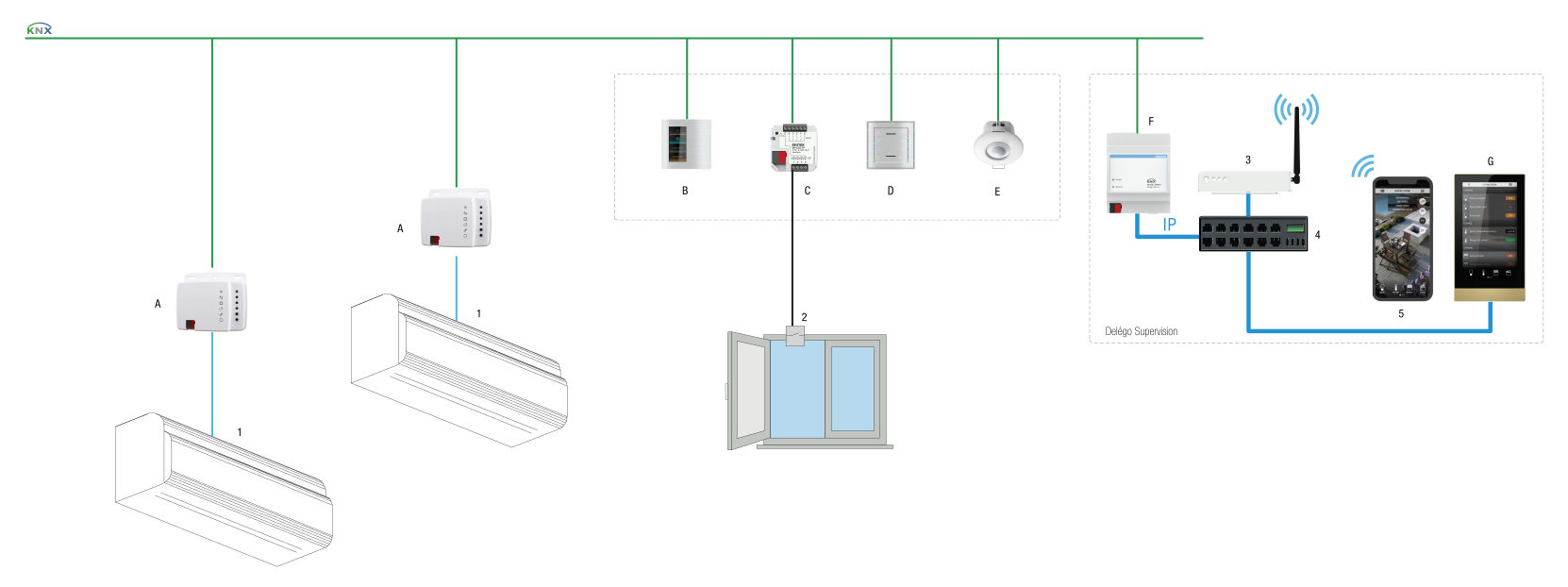
| Ekinex devices | Other system components |
|---|---|
A)Controller VRF EK-AI6-TP | 1)VRF unit |
B)Pushbutton Signum EK-EV3-TP-TER | 2)Window opening sensor |
C)Universal interface EK-CD2-TP | 3)IP Router |
D)Multisensor EK-ET3-TP | 4)IP Switch |
E)Presence sensor EK-SG2-TP-M | 5)Delégo APP |
F)Server Delégo EK-DEL-SRV01 | |
G)Touch-panel Delégo EK-DEL-xPAN... |
Control with Ekinex
In general, VRF systems have their own communication bus system between the various constituent equipment; by means of the VRF control interface with KNX communication EK-AI6-TP (A) it is possible to interface Ekinex control devices, such as pushbutton panels equipped with EK-EV3-TP-TER thermostat (B), EK-ET3-TP multisensors (D), EK-SG2-TP-M occupancy sensors (E) or EK-CD2-TP universal interfaces (C) connected to window opening sensors, to the communication bus dedicated to air conditioning performed with VRF and split-type heat exchange terminals.
Available controls* include:
- on / off
- mode (Cool, Heat, Auto, Fan)
- fan speed
- temperature setpoint
- feedback of room temperature
- diagnostics
- consumption monitoring
The device is available with communication interface for manufacturers Daikin, Mitsubishi Electric, Toshiba, Panasonic, LG, Samsung and others.
*) Some control and monitoring features may not be present or may be limited based on individual manufacturers' VRF/VRV unit models.